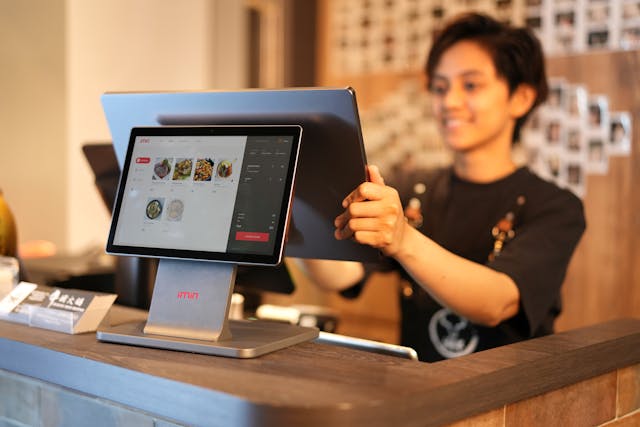
As more and more guests are digitally literate, they expect fast service, easy ordering, and transparent payment, while the hospitality industry is finding it increasingly difficult to find a workforce while also wanting to maintain profitability. That is why digitalization in the hospitality industry is no longer just a trend, but a necessity for successful hospitality businesses.
Digital Systems in Hospitality
We are aware of the need for ERP, POS, and mobile ordering systems to work together to avoid certain problems, such as multiple manual entries, unreliable inventory data, slower guest service, and missed sales opportunities. All of these problems can lead to a number of other business issues, which is not anyone’s goal. Therefore, the integration of ERP, POS, and mobile ordering enables the automation of business processes, better cost control, growth in turnover and average consumption, and better decision-making. From this, we can conclude that they contribute to both the hospitality industry and guests, which is the basis of modern, profitable hospitality.
A POS system for restaurants and cafés today must be fast, stable, and adaptable. Some of the key advantages of a POS system are fast receipt and processing of orders, real-time operation, review of sales by item, waiter, or shift, simple management of prices and promotions, and fiscalization in accordance with regulations.
ERP systems in the hospitality industry are often invisible to guests, but they are crucial for profitability. They offer real-time warehouse and inventory monitoring, precise procurement planning, input cost control, and insight into actual profits, not just turnover. It is important to connect the ERP to the POS system because, in this way, every sale automatically updates inventory, makes it easier to identify defective items, and optimizes the menu based on real data.
Mobile ordering in the hospitality industry is today the key to a modern customer experience, which is why it has become a standard, especially in cafés, restaurants, beach bars, food courts, festivals, and events. Today, guests expect to be able to order without waiting, view a digital price list, pay without cash, and have control over their own order, which mobile ordering enables them to do. Mobile ordering also brings many advantages, such as shorter waiting times and higher turnover, fewer order errors, a higher average bill value, and less burdened staff.
How does integration and cashless payment affect revenue?
When mobile ordering is integrated with POS and ERP systems, the entire process becomes automated and therefore more efficient. This means that more orders are placed because faster service allows more guests to be served at the same time. Digital price lists and mobile ordering encourage additional purchases (drinks, desserts, side dishes), which leads to higher average spending. As a result, guests are satisfied because they wait less, have more control, and enjoy a more modern experience. Better cost control is also achieved thanks to ERP systems, which reduce losses and unnecessary purchases. Therefore, smarter decisions are made because real-time data allows for quick adjustments to prices and offers. All of this together benefits restaurants and leads to higher revenue and long-term business sustainability.
Cashless payments also contribute to higher revenue due to faster transactions, shorter lines, greater security, and easier traffic monitoring. The integration of cashless solutions also contributes to speed and efficiency, especially in high-traffic establishments. As a result, operations become easier and simpler, and guests are more frequent and satisfied.
Cashless offers you not only a POS system, but a complete solution for the digitalization of the hospitality industry that connects a POS system, ERP integrations, mobile and digital orders, digital price lists, and cashless payments. Our goal is not only technology, but also the satisfaction of our users, to whom we offer the most modern and innovative solutions.

